Weddings
Wedding speech photography: speakers and reactions
How to photograph a wedding speech by pairing the person speaking with the people listening, in both wide and close frames.
By Tyler Rivera 8 min read
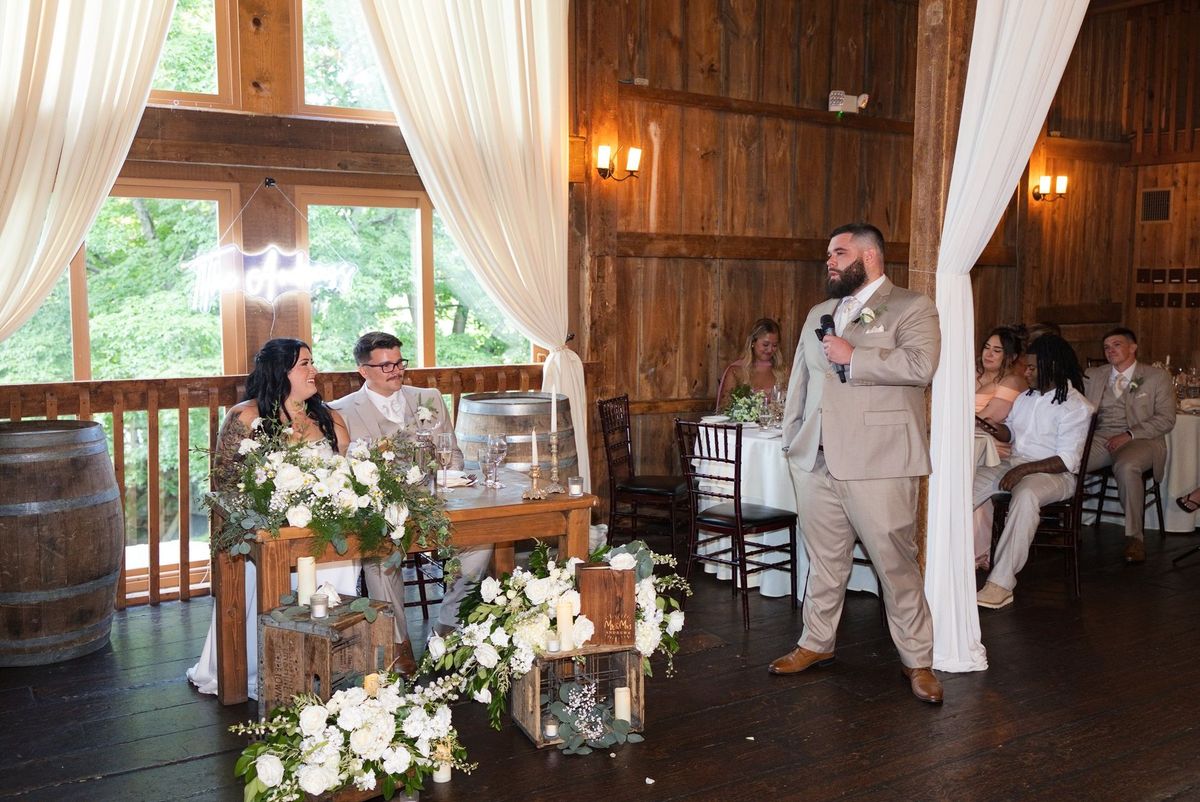
Speeches ask a photograph to do something unusual: show a person talking, and show everyone else listening. There is no action to freeze, the room is often dim, and the most important thing happening is a voice. Yet speeches produce some of the warmest pictures of a reception, because they are full of faces. This guide looks at how to plan for them, which choices help the pictures and which questions are worth asking before the evening. Examples come from three weddings, Mariana and Max's at Maneeley's, Sadie and Mat's at The Barns at Wesleyan Hills and Jacob and Thea's at Warehouse 635.
Why are speeches harder to photograph than they look?
A speaker usually stands in one place, holds a microphone or a glass and faces the room. That is a good deal less visual than a dance or a ceremony, and the mood depends on laughter, pauses and reactions that cannot be predicted.
Lighting adds difficulty. Speeches often happen in a dim room, with a single spot of light or none at all, and a speaker who moves in and out of it. The background is often a mix of tables and glassware. These are conditions that call for judgement, and they are one reason it helps to talk to the venue about lighting before the day.
The best response is variety. A single frame of a speaker at a microphone is rarely the most memorable picture. The set becomes interesting when it combines the speaker, the listeners and the room.
What does a wide frame show?
A wide frame is useful because it puts the speaker in context. It shows where the person stands, who is nearby and how the room is arranged.
In the frame on the cover of this guide, from Sadie and Mat's reception, a speaker gives a toast beside the couple's table, and the room is visible around them. That is the picture that answers the question of what the scene was like, and it is the one that makes the close frames meaningful.
Choosing a position for the speeches is therefore worth a moment of thought. A speaker who stands close to the couple makes it easy to show both in one frame, while a speaker at the other side of the room invites a wider composition. Neither is wrong, but you can choose which you prefer.
What does a close frame add?
A close frame of the speaker records expression: the pause before a joke, the smile at an old memory, the effort of holding back emotion.
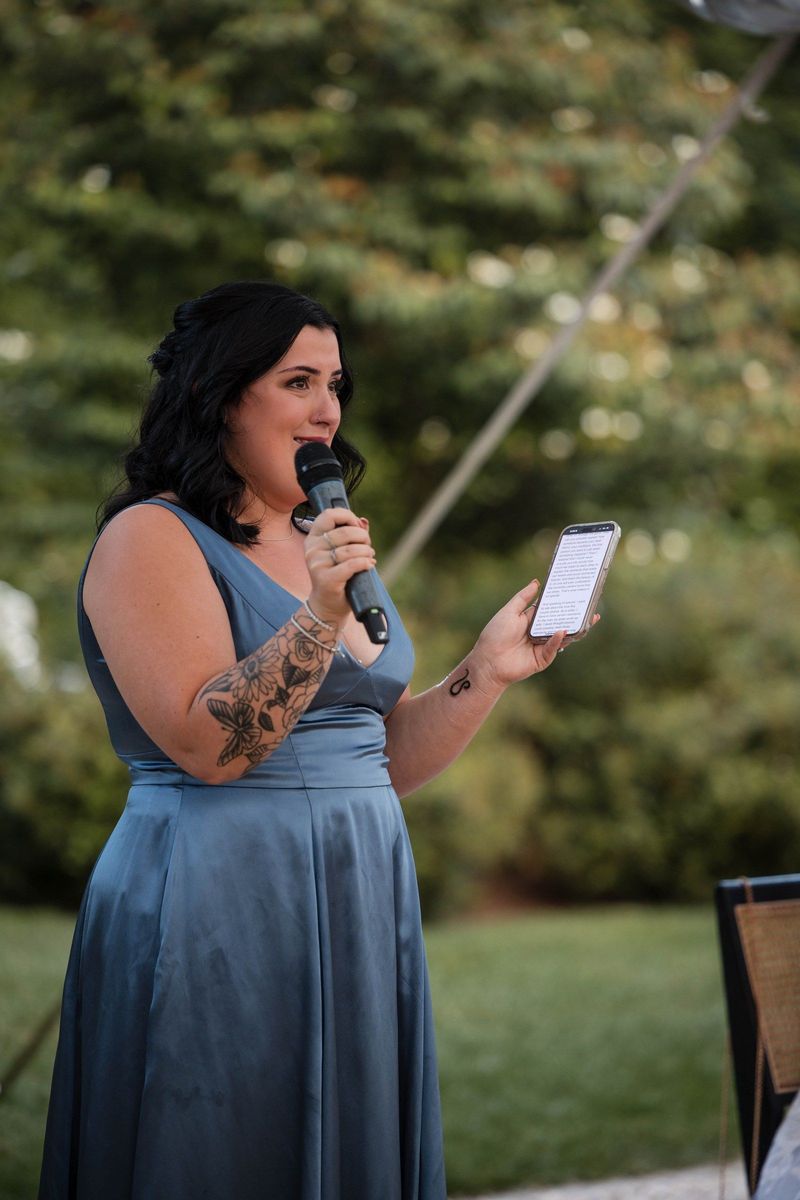
The frame above, from Sophia and Tommy’s reception, shows a wedding guest speaking into a microphone while holding a phone, and it is the picture a speaker is likely to want afterwards. People rarely see themselves speaking, and the pictures show a version of them that is both familiar and new. More from that evening is in the Sophia and Tommy story.
If you have asked a friend or relative to speak, it is thoughtful to let them know there will be a camera nearby and roughly where it will be. Most people relax when they know what to expect, and the pictures improve as a result. It also helps to let the speakers know whether they will be holding a microphone, standing at a lectern or speaking from a table, so they can choose where to look.
Why do listeners matter?
The most telling pictures of a speech are often the reaction frames. A laugh, a hand over a mouth, a quiet nod and a tear are all part of the same story as the words.
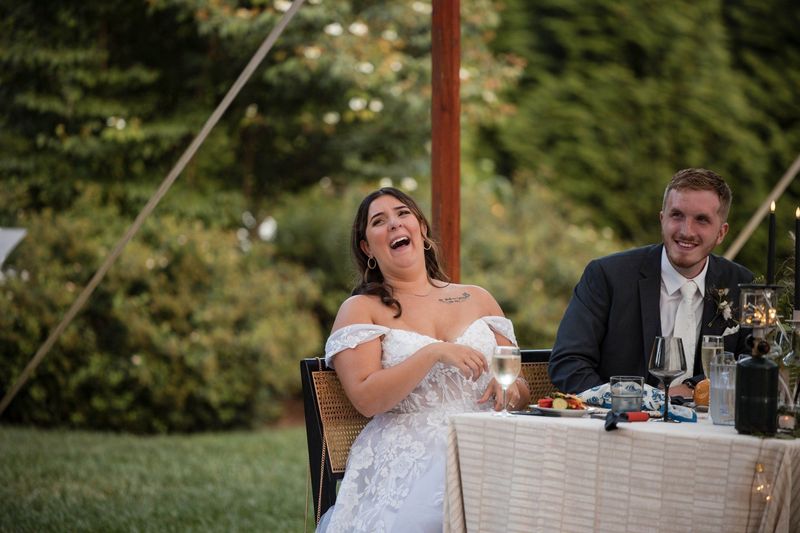
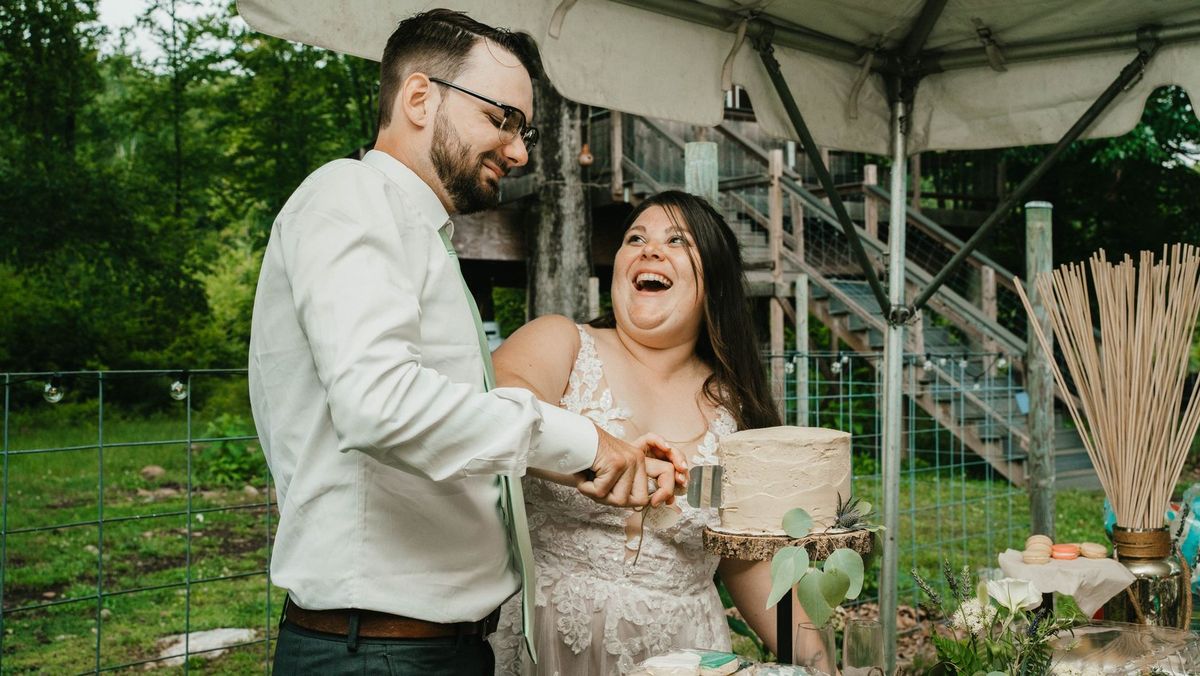
In the frame above, Sophia laughs with her head tilted back while Tommy smiles at the reception table. It shows how the couple are present for the moment, and a viewer can see their enjoyment even without knowing what was said. Paired with the cover frame, it completes the exchange between the person speaking and the people listening.
A set that only features the speaker leaves out half the event. If there are particular people whose reactions you would love to see, perhaps a parent, a grandparent or a close friend, mention them in advance. A short list of names or table numbers is enough, and it helps those frames happen rather than hoping they do.
Remember, too, that reactions work better when they are not interrupted. A listener who is asked to look at the camera stops listening, and the picture loses what made it interesting.
How do toasts bring everyone into the picture?
A toast is a gift to a photographer, because it brings the whole room into one gesture. Glasses go up, faces turn and the wide frame becomes full of movement.
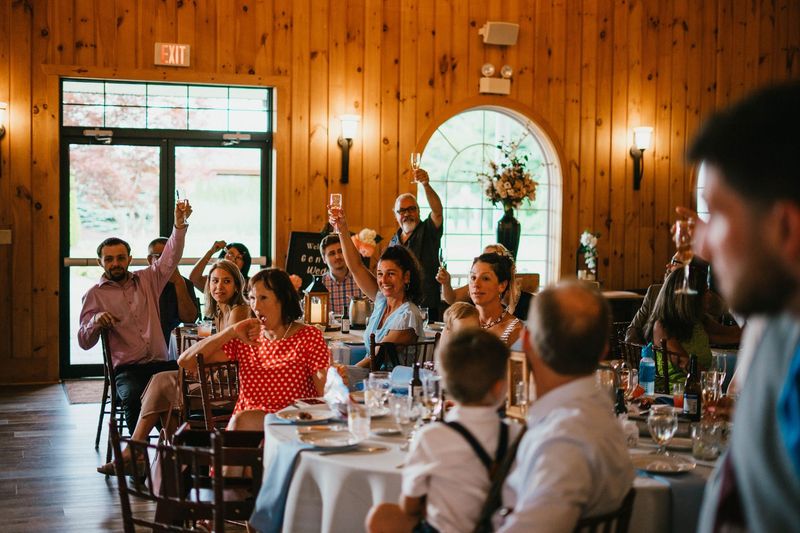
The raised glasses above, from Mariana and Max's reception, show the point. It is a picture of the guests as a group, and it records the feeling of a room acting together. It is the natural close to a speech and a good final frame for the chapter.
To help toasts photograph well, make sure glasses are filled before the speeches begin, and tell guests when to stand or raise them. Confusion about when to lift a glass leads to ragged, late gestures, while a clear cue leads to a confident, simultaneous one. A simple line from whoever is hosting, such as "please raise your glasses," is usually all it takes.
How can you help speakers feel at ease?
Most people who give a wedding speech are not professional speakers, and nerves show in a photograph as stiffness or a fixed smile. A few kind gestures from the couple make a difference.
Share the plan early so no one is surprised by the order or the microphone. Offer a place to put notes, a glass of water and a spot to stand where they can see the couple. Suggest, gently, that they look at the people they are speaking about; it produces warmer expressions than reading from a page.
If a speaker is anxious, a short word from the couple before they begin often calms them. A speaker who feels supported tends to smile, pause and enjoy the laughter, and those are the moments that become good pictures. It is also fine to let someone read from notes. A page in the hand is a natural part of the scene and does not spoil a frame.
What choices do you have about the room?
The room shapes every speech picture, and a few adjustments are within your control. Where the couple sits determines what appears behind the speaker, so a table with a plain wall behind it is easier to photograph than one in front of a busy buffet.
Lighting is the next choice. Ask whether the venue can brighten the area where speakers will stand, even slightly, and whether a spotlight will be used. Candles and warm lamps look lovely in person, but a speaker standing between them can be hard to see, so a little extra light near the microphone helps.
Finally, think about the path to the microphone. Speakers who have to squeeze between tables arrive flustered, while those who have a clear route arrive calm. A tidy, open path also gives the pictures of someone standing up to speak a clean, unhurried start.
What kinds of speech frames are worth asking for?
It helps to know the range of pictures a speech can produce, so you can say which you value. The first is the establishing frame: speaker, couple and room together. The second is the portrait of the speaker, close and expressive. The third is the reaction of the couple, which often tells more than the speaker's face. The fourth is the reaction of particular guests, such as a parent or a friend. The fifth is the group moment, such as a toast.
Not every speech needs all five, and a short toast may only warrant two or three. But asking for a spread means the set does not end up with ten versions of the same angle. You can also say what you are less interested in; some couples would rather have fewer pictures of the speakers and more of the listeners, or the reverse.
Lastly, remember that some of the best frames happen right after a speech ends, in the hug, the handshake or the shared laugh. Allowing a few seconds for them before the next speaker begins gives the set a warm closing beat.
What can you decide about the order and the number of speakers?
Planning the speeches is partly about the pictures and mostly about the room. A few decisions help both.
Think about how many people will speak. A long list can wear out an audience, while a short one gives each speech more weight. Some couples ask each speaker to keep within a time they choose, and a quiet word beforehand is kinder than an interruption.
Think about where in the evening the speeches fit. Before the meal, people are fresh and attentive; after it, the room is often warmer and more relaxed. Either can work, but it is worth deciding on purpose, because it affects light, energy and what the guests are holding.
Think about who introduces whom. A host or master of ceremonies who announces each speaker gives the evening shape, and it tells Legend when to be ready. If you have a written order, share it.
What about film and audio?
If your wedding includes film, speeches are a point where planning really matters, because sound is involved. A speaker who is audible in the room is not always audible on a recording, and a quiet word with the venue and whoever runs the sound can prevent problems.
For photographs alone, sound is less of an issue, but a microphone still changes how a speaker stands and where they look. The wedding video shot list is a helpful resource if you are making a list of moments to cover, and the wedding photo and video timeline shows where speeches might fall in a whole day.
How does this fit the finished story?
In the Mariana and Max story, the speeches sit within the reception, alongside the first dance and the cake. In the Sadie and Mat story, they have a chapter of their own, with a speaker's toast and the couple's reaction shown side by side. The guide to first-dance photography covers the dance, and the guide to cake-cutting photography covers another reception moment. To learn about the services, see wedding photography and wedding photography and videography.