Weddings
Wedding ceremony photography: the aisle, exchange and first kiss
Plan wedding ceremony photography from the aisle to the rings and first kiss, with outdoor examples from Maneeley’s, The Barns at Wesleyan Hills and a farm wedding.
By Tyler Rivera 8 min read
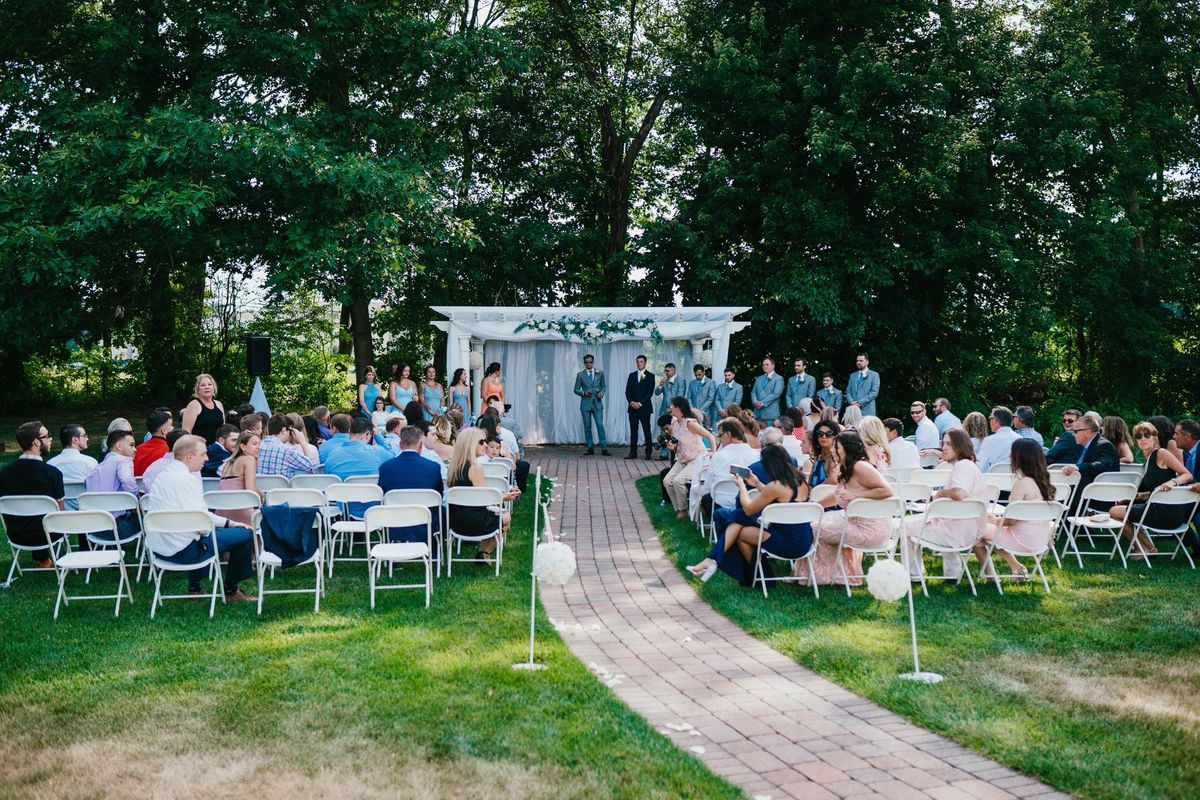
The ceremony is the one part of a wedding that cannot be repeated, so its pictures carry a particular weight. It is also the part of the day with the most rules, from venue policies to the wishes of whoever leads the ceremony, which means a little preparation changes what can be photographed and from where. This guide follows the chain of ceremony moments, from the setting and the aisle to the exchange, the kiss and the exit, and suggests choices you can make before the day. Examples come from five ceremonies, four outdoors and one in a City Hall atrium: Mariana and Max's at Maneeley's, Sadie and Mat's at The Barns at Wesleyan Hills, Ashley and Anthony's on a farm, Jacob and Thea's at Spicebush Pond and Christina and Tajay's at Hartford City Hall.
What should you ask the venue and the person leading the ceremony?
Most of the planning is a series of questions, and the answers shape the pictures more than anything else. It helps to ask them early, because some rules are firm and some can be discussed.
- Are there places cameras may not stand, such as the aisle or in front of the first row?
- Is movement allowed during the ceremony, or should cameras stay in fixed places?
- Is flash permitted, and are there lighting conditions that affect what is possible?
- Will there be a microphone, and where will the people speaking stand?
- Is there anything in the ceremony that should not be photographed or filmed?
Write the answers down and share them. If you plan to have both photographs and film, the same answers help everyone work without getting in each other's way. The timeline tips for your videographer cover the filming side in more detail.
Why start with the setting?
A ceremony set is easier to understand when it begins with the place. A wide view shows where people will sit, where the couple will stand and what surrounds them. Think of it as the establishing shot of the chapter.
Small details belong to the setting as well. Some couples ask guests to put their devices away during the ceremony, and a sign saying so becomes part of the story. Signs, programmes, flowers on chairs and an arch or arbor all help a viewer see the place as the guests did.
If you want these pictures, it helps to leave the space tidy and ready until they are made. Chairs that are filling up or an aisle that is already busy change the frame, so it is worth asking when the pictures of the empty setting can happen.
What does the aisle show?
The aisle is the first moment when attention turns toward the couple. It is a good subject for a picture because everything in the frame points the same way: the guests, the path and the person walking.
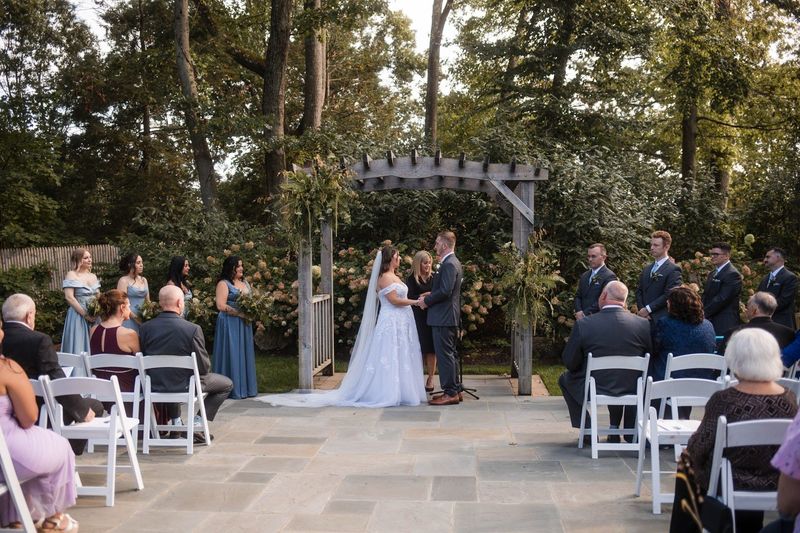
The frame above shows where the aisle leads: Sophia and Tommy stand beneath the arbor with seated guests in a wide view of their garden ceremony. In the Sophia and Tommy story, earlier frames show the empty benches and Sophia walking down the aisle beside a companion. In the Christina and Tajay story, an earlier frame shows Christina walking down the aisle with a loved one, and a later one shows the couple facing their guests beside the officiant. In the Ashley and Anthony story, a wider frame follows Ashley walking down the outdoor aisle with a loved one. In the Sadie and Mat story, a tall frame follows Sadie smiling as she walks down the outdoor aisle with a family member, and in the Mariana and Max story a vertical frame shows Mariana walking down the aisle with a companion, which emphasises the length of the path and the person at the centre of it.
As a general rule, the aisle is best photographed from more than one position. A view from the front shows faces and expressions, and a view from the side or behind shows the guests turning. If you want both, the positions need to be agreed with the venue ahead of time.
Think too about who walks and in what order. You do not need to tell Legend every detail, but knowing the sequence helps the frames follow it. A short note listing who walks, who is already at the front and who sits where is usually enough.
How do the exchange and the kiss work as pictures?
The centre of a ceremony is usually quieter than people expect. What is said is often soft, and what is visible is often small: a glance, a hand, a pause.
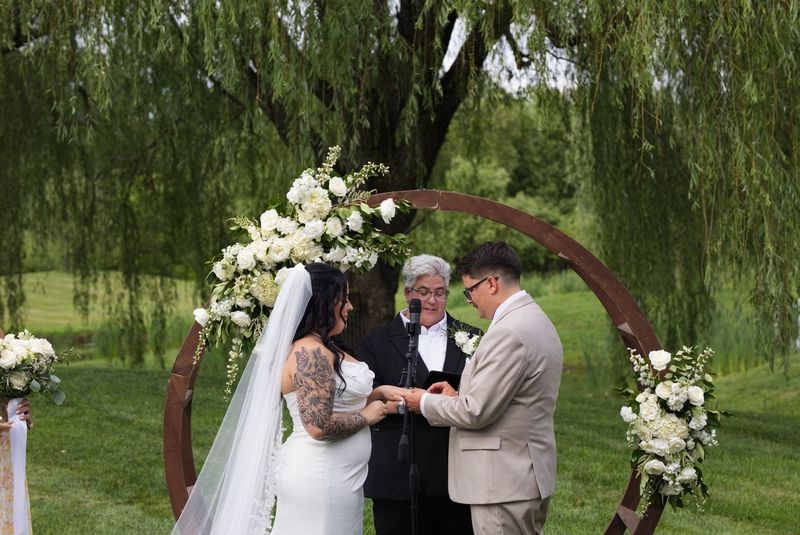
In the frame above, Sadie and Mat exchange rings beneath the circular floral arch. The wide format keeps the arch around them, so the picture shows the exchange and the structure that frames it. The Mariana and Max story has a close, quiet counterpart, in which the couple look down toward their hands during the ceremony.
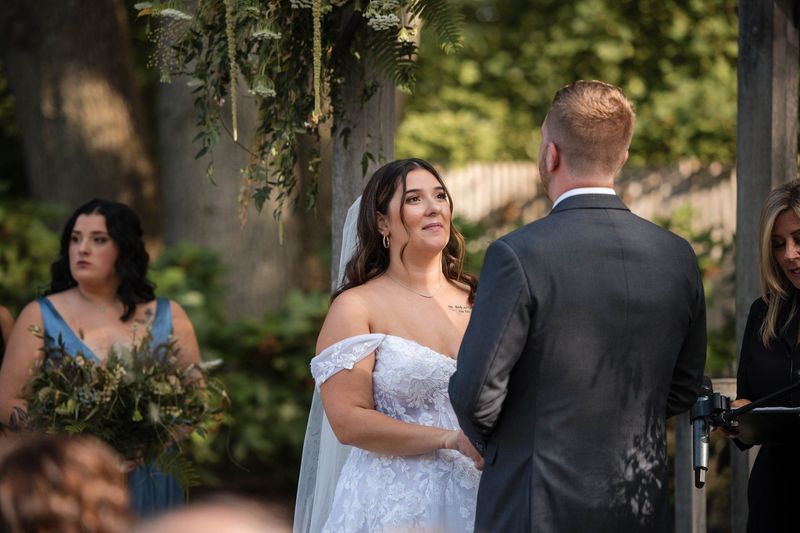
If there are readings, music or rituals in your ceremony, share the order so the key moments are not a surprise. The kiss is the moment everyone expects, and it is worth photographing from a position that includes the surroundings. A kiss framed by an arbor, an aisle or a crowd tells a viewer where it happened as well as what. The frame below, of Sophia watching Tommy with a soft smile during their garden ceremony, shows the quieter side of the same moments: the expression between the big events.
Think about whether you would like pictures of the whole kiss or a small selection. Some couples prefer a simple, brief kiss; others make more of it. Either is fine, and saying which you prefer lets the frames match.
Why do reactions matter as much as the couple?
A ceremony set that only shows the couple misses half the event. The people watching, smiling, laughing or wiping their eyes are part of the same moment, and their faces often explain how the room felt.
When you plan, think of the people whose reactions you would most like to see. It may be someone sitting near the front, a child, a friend or a relative. Telling Legend who they are, by name or by where they will sit, helps those frames happen. You do not need to give a long list; two or three names are enough.
It also helps to think about the guests as a group. A wide frame of applause or laughter conveys atmosphere in a way that a single face cannot, and it is a useful companion to the close frames.
How should readings, music and traditions be handled?
Readings, songs and traditions are among the most personal parts of a ceremony, and they are also among the easiest to miss if nobody knows when they will happen. A one-page outline of the order is enough. It should say what happens, roughly in what sequence, and where each person will stand or sit.
Where a tradition involves movement, such as lighting something, walking to a particular place or involving a group, mention it so the pictures can be made from a helpful angle. Where a moment is meant to be private, say that instead. Nobody is offended by a clear preference, and a clear preference prevents awkward moments later.
Music affects pictures indirectly. A processional gives the aisle a rhythm, and a quieter piece during the exchange sets a mood. Knowing which is which helps the frames follow the pace of the ceremony instead of working against it.
What about guests and their phones?
Guest phones are now part of most ceremonies, and they influence the pictures. A guest who holds up a phone in the aisle can block the view, and a row of raised screens changes the look of a frame.
Some couples ask guests to put devices away so everyone can be present and the aisle stays clear. If you do, say so clearly beforehand, and perhaps again at the start, so people are not surprised. A small sign near the entrance helps, and so does a quiet word from whoever opens the ceremony.
Other couples prefer a relaxed approach, and that works too. In that case, the pictures will include some phones, and that is a fair record of a modern ceremony. The choice is yours; the useful step is to make it deliberately, so the day matches what you expect.
How does the exit close the sequence?
The exit is the ceremony's last picture. It gives the set a conclusion and lets the viewer see the couple as newly married, often looking relaxed after the main event. Walking back down the aisle mirrors the walk that began the ceremony, so the two frames work well as bookends in a finished story.
If you would like a specific exit, such as pausing for a moment at the end, being greeted by guests or walking out through a particular doorway, mention it. Otherwise, an unplanned exit often produces the most natural frames.
After the exit there may be a short break before the next part of the day. Using that moment for a few quiet frames of the two of you, away from the crowd, can add a gentle final page to the chapter.
What choices can you make about light and weather?
Outdoor ceremonies bring their own questions. The direction of the sun, the shade of trees and the possibility of weather all affect the pictures. If you are planning an outdoor ceremony, ask about a sheltered alternative so the plan is not rebuilt at the last minute, and think about where you would like to face. Light on faces is generally kinder than light behind them, so the placement of the couple can be worth discussing with the venue.
Indoor ceremonies bring different questions, mainly about lighting and space. Dim rooms can limit what is possible without flash, so it helps to ask about the lighting in advance and whether it can be adjusted.
Time of day plays a part too. Late-afternoon light tends to be warm and flattering, while midday sun can be harsh and create strong shadows under hats and brows, so the start time you choose has a visible effect on the pictures. In both cases, a calm approach helps. Pictures made in imperfect conditions can still be beautiful, and a flexible plan is more useful than a perfect one.
How does the ceremony fit into the finished story?
In the Mariana and Max story, the ceremony chapter follows the outdoor setting through the aisle and the exchange to the close of the ceremony. The Sadie and Mat story follows a different setting, with chairs leading to a circular floral arch beneath willows, and the Ashley and Anthony story places the ceremony beneath a wooden arbor on a farm, and the Christina and Tajay story moves from the aisle through the ring exchange to a kiss and an exit inside the Hartford City Hall atrium. The reception follows in the guide to first-dance photography, and the wider schedule is covered in the wedding photo and video timeline.
To learn about the services, visit wedding photography or wedding photography and videography.