Weddings
Wedding party and family photographs: groups with personality
How formal and playful group pictures can stay quick and relaxed, with a short list, a helper who knows everyone and room for a laugh.
By Tyler Rivera 8 min read
Wedding party and family photographs are the pictures most likely to end up on a mantelpiece, and also the ones most likely to go wrong when nobody has planned them. Too many people, too little time and no clear order can turn a happy part of the day into a stressful one. A small amount of preparation prevents this. This guide covers how to choose which groups to photograph, how to order them, how to keep a formal picture and a playful one in the same set, and how to make the process comfortable for everyone. Examples come from five weddings: Mariana and Max's at Maneeley's, Sadie and Mat's at The Barns at Wesleyan Hills, Ashley and Anthony's farm wedding, Jacob and Thea's at Spicebush Pond and Christina and Tajay's at Hartford City Hall.
Why does a group list help?
A group list is a short document naming the combinations of people you would like to photograph. It does not need to be elaborate. A few lines such as "couple with parents on one side" and "couple with all grandparents" are enough.
The list does three things. It tells Legend what matters to you. It lets you ask a few people to help gather the groups. And it prevents the common situation where a group picture is missed because nobody thought of it until the party had moved on.
Keep the list realistic. Every group takes time to assemble, and the longer the list, the more the day is spent on it. Many couples find that prioritising the combinations they truly want, then adding others only if time allows, keeps the process relaxed. As a general rule, a short list done well beats a long list done in a hurry.
How do you order the groups?
The order of groups affects how smoothly the session goes. A useful rule is to begin with the largest group and work down to the smallest. A large gathering is easiest to arrange while everyone is still together, and each following picture releases people to go and enjoy the rest of the day.
Another is to keep related groups close together in the sequence. If you photograph one side of the family and then the other, relatives are not asked to come back later. And putting elderly relatives or small children early in the order spares them a long wait.
Choose someone to help call out names. A friend or relative who knows the faces can gather people quickly, while a stranger takes longer. That person does not need to be formal; a loud voice and a list are enough.
What does a formal wedding party frame look like?
A formal frame is the classic wedding party picture: everyone facing the camera, arranged by height or role, smiling.
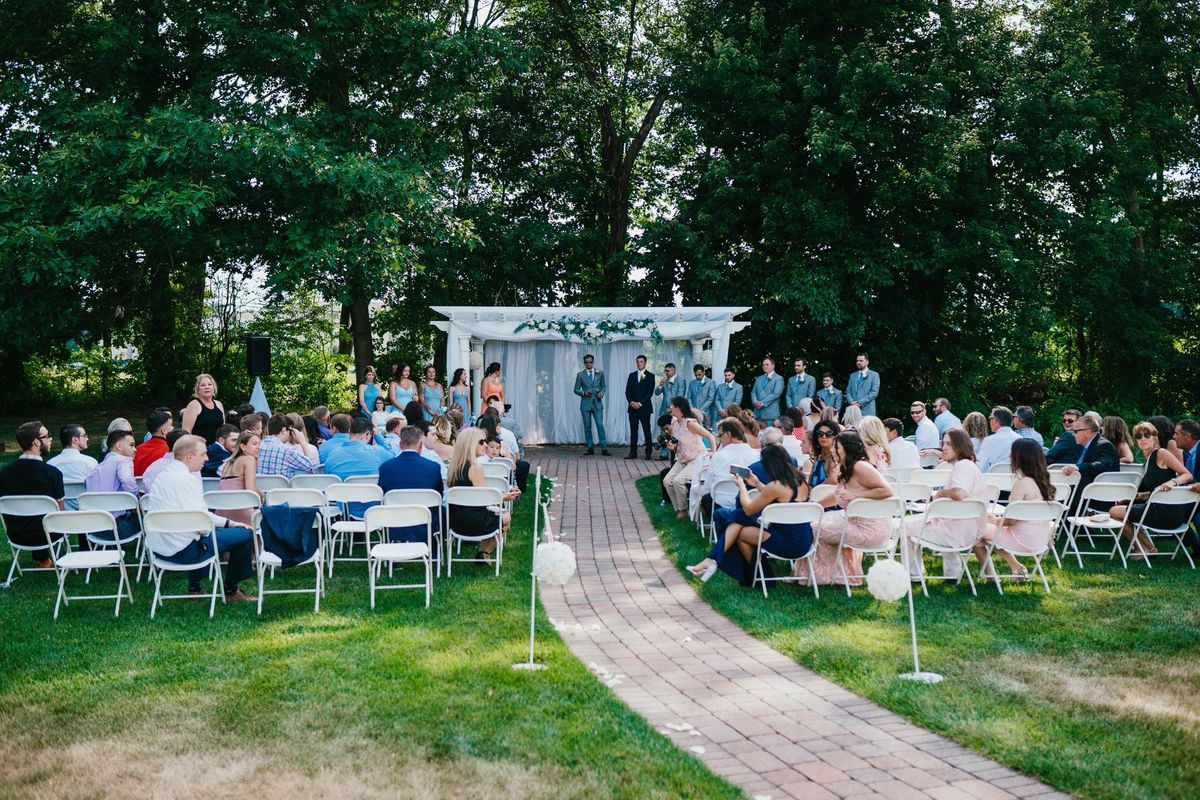
The formal wedding party pose in the Mariana and Max story is a clear example. Pictures like this have a clear purpose. They record who was there, in what clothing, and standing next to whom, and they are the frames that get printed for the wall or sent to relatives.
A few things help. Make sure everyone can see the camera, which usually means no one is hidden behind another person's shoulder. Check hands, bouquets and jackets before the frame is made. And decide where the couple stands: in the middle is classic, and at one side is less formal.
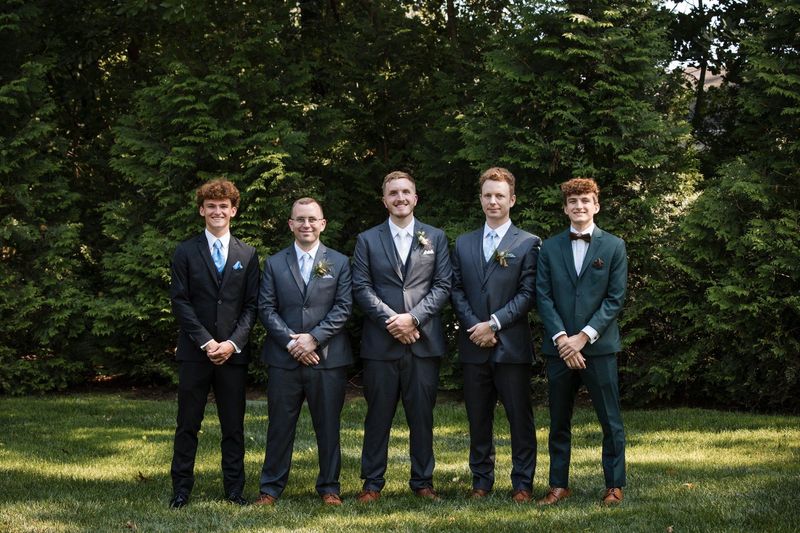
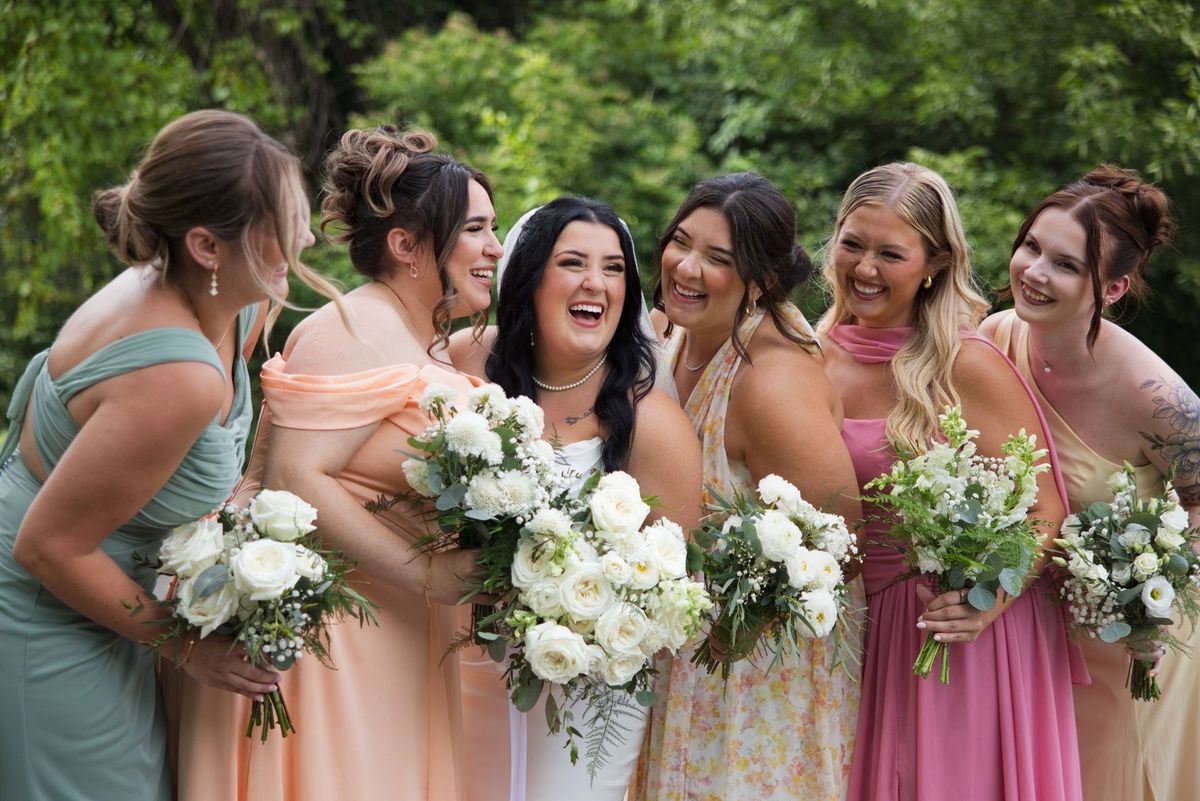
The frame above shows Tommy with the groomsmen in a coordinated garden group portrait, a classic arrangement that uses the lawn and planting behind them. A good set also includes a playful frame. The cover of this guide, from Sadie and Mat's wedding, is a looser frame as well: Sadie laughs with her wedding party and their bouquets. Next to a formal pose, frames like these show different sides of the same group.
How do you photograph adults in formal groups?
Group portraits of adults, such as a couple's families, follow the same logic but with a few extra considerations. People differ in height and comfort, so arranging them thoughtfully matters.
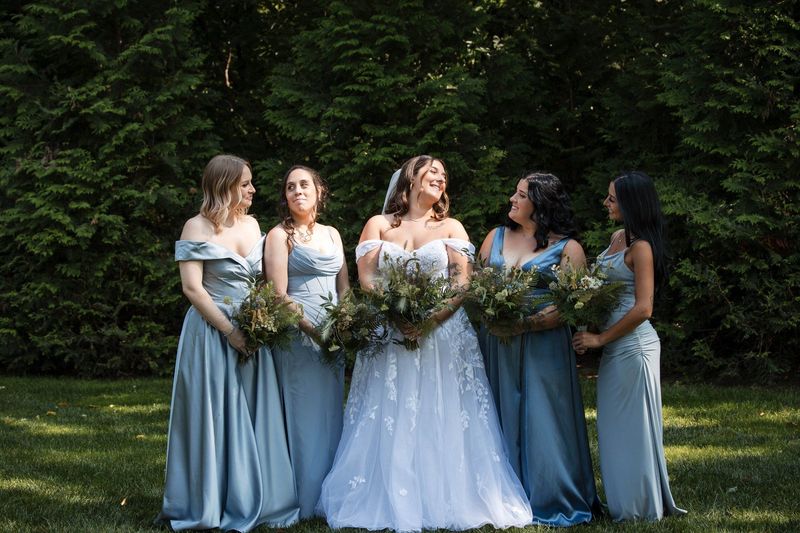
The group above shows Sophia laughing with the bridesmaids while they hold bouquets on the lawn, an example of how a group can share one frame with the setting behind it. More from that garden is in the Sophia and Tommy story. An arrangement this size takes a moment to build, and it is worth allowing that time. In the Sadie and Mat story, the couple also pose with a large family group, and a separate frame shows them with their wedding party beside the ceremony lawn.
Make sure the people who matter most to you are easy to see. Those who are older, shorter or less steady may prefer to be seated or to stand at the front. Bear in mind that some guests find standing for long periods difficult, and keeping groups quick shows consideration.
It also helps to take more than one frame of each group. People blink, look away and laugh at the wrong moment, and a few frames give you the best chance of one where everyone looks good.
Where is the best place to gather everyone?
The location for group pictures affects how smoothly they go. A good spot has even light, enough room for the largest group and a background that does not distract. Shade is often kinder than direct sun, because it avoids squinting and harsh shadows on faces. A wall, a line of trees or a building front can all work.
Think also about how easy the spot is to reach. A long walk over uneven ground is hard for some guests, and a spot far from the reception takes people away from the party. Choosing somewhere close to where people already are makes it easier to gather them quickly.
Ask the venue about options, and consider a backup in case of rain. A covered porch, a lobby or a large room with good light all work as alternatives. Deciding on the fallback in advance spares you a scramble when the weather changes.
How do you make group pictures quick and friendly?
Speed and friendliness go together. People are happier when they know what is happening, so a brief explanation at the start helps: who is being called, where to stand and roughly how long the process will take.
Keep your own energy light. A smile and a joke from the couple relax a group more than any instruction. If someone looks nervous, a warm word can change the mood.
Let the process breathe between groups. A few seconds to adjust, to straighten a jacket or to pick up a child makes the next frame better. And thank people as they leave; it costs nothing, and it makes them glad they came.
When the list is finished, consider a final informal frame of everyone at once, laughing, waving or cheering. It is often the one that guests remember best, and it closes the session on a happy note.
What details help the pictures look good?
A few small checks before each frame make a visible difference. Look at the edges: stray bags, drinks or phones are easy to remove before the picture and hard to remove afterwards. Look at clothing: collars, ties, hems and sleeves can be adjusted in seconds. Look at hands: bouquets, boutonnieres and pockets give people something to do with their hands, and an empty hanging hand can feel awkward.
Look at faces, too. Asking a group to take a breath and relax their shoulders before the shutter is a tiny instruction that changes expressions noticeably. And asking people to look at the camera, then at each other, gives you two different frames from the same grouping.
Finally, consider the tallest and shortest people. Arranging them so that everyone's face is visible, with taller people at the back or sides, makes the picture work. That small piece of thought is often the difference between a pleasant group picture and a frustrating one.
What about children and informal groups?
Children change the rhythm of a group session. They are tired of waiting long before the adults are, and their patience runs out quickly. Putting them early in the order, keeping their pictures short and letting them move on helps everyone.
Informal groups are a way to make the session lighter. A group of friends laughing together, a family sitting on the ground or a gathering of children on the lawn can look more natural than a formal line.
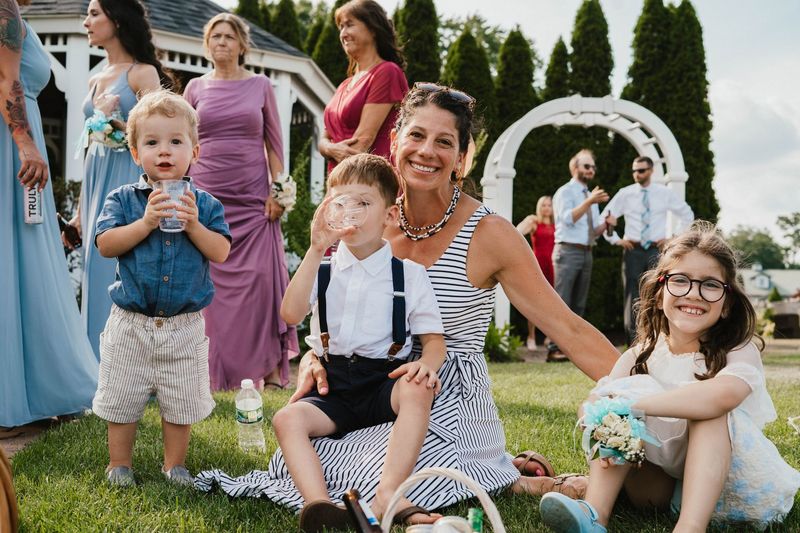
The frame above, from Mariana and Max's wedding, shows guests and children seated together on the grass. It is relaxed, and the sense of closeness is easy to feel. A casual arrangement like this is worth considering alongside the formal ones, and it often becomes a favourite.
If you have a particular tradition, such as a family sitting in a certain way or a group wearing something special, mention it. Details like that are easy to forget until the moment has passed.
How can you handle family dynamics?
Families are complicated, and group pictures can bring that to the surface. The kindest thing is to think about it in advance. If there are relatives who are not on good terms, consider photographing them in separate groups. If someone is uncomfortable being photographed, a quiet word before the day gives them a chance to say so.
Be clear about who is in charge of the session. A single organiser, whether a family member, a friend or the host, prevents several people from giving conflicting instructions. You can also ask Legend to guide the groups, which allows you to relax.
Finally, give people a reason to be patient. A short note in the invitation or a quiet word at the ceremony, saying roughly when group pictures will happen and where to meet, makes them much more likely to be there and ready.
How does this connect to the finished story?
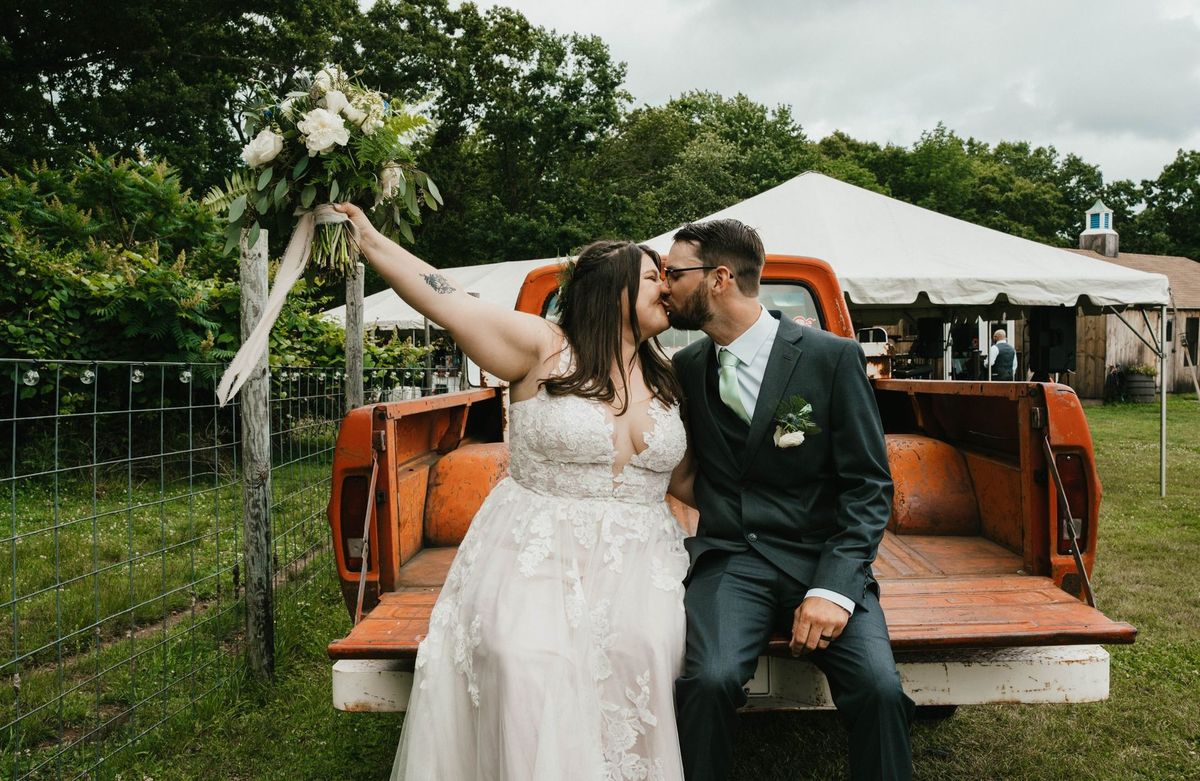
In the Mariana and Max story, the wedding party has its own chapter, mixing formal and playful frames. The Sadie and Mat story has one too, with the wedding party and a larger group, and the Ashley and Anthony story gathers the wedding party and family around an orange pickup truck, and the Christina and Tajay story places the wedding party and family on the staircase and atrium floor of Hartford City Hall. The guide to couple and bridal portraits covers the portrait side of the day, and the wedding photo and video timeline shows how to leave time for groups.
To learn about the services, see wedding photography and wedding photography and videography.