Start with one viewer and one action
The most useful question we ask at the start of a promotional video is not about style. It is: who is watching, where are they when they see it, and what should they do in the next minute? A video for a homeowner scrolling at night wants a different opening than one for a purchasing manager who clicked from a quote request.
Write the answer as a single sentence. For example, “A facility manager who has never heard of us should understand that we repair rooftop units and call for a site visit.” That sentence becomes the filter for every later decision. A shot, a line of dialogue or an animation that does not help that viewer take that step is a candidate for the cutting room.
Promotional video is also not the same job as a brand story or an explainer. A brand story spends time on origin and values. An explainer teaches how something works. A promotional video compresses the case for choosing you into a short piece that can be shown cold.
Hook, value and action
Most good promotional videos follow three beats, even when the viewer never notices them. The hook earns the first few seconds. The value shows what is different or useful. The action tells people what to do.
The hook
A hook is not a gimmick. It is the most specific true thing you can say or show at the start. A person on camera describing the problem you solve, a moving shot through the working part of your shop, or a plain statement of who you serve can all work. Avoid opening with a logo animation or a long thank-you; viewers decide quickly whether to stay, and a logo gives them no reason to.
The value
The middle should show evidence, not adjectives. If you say you are careful, show the careful step. If you say customers return, let a customer or a long-time employee say why, in their own words. We plan these moments during the shoot so there is something real to cut to when a sentence needs support.
The action
End with one clear step: call, request a quote, book a visit, see the menu. If a video offers three actions, most viewers take none. The action should match where the video lives. On a service page it can point to the form below. In a social post it may be a short line and a link in the caption.
Choosing format, runtime and platform
Runtime follows the platform and the question being answered, not a fixed number. A video sitting on a service page can run longer because the visitor already has interest. A social feed cut has seconds to prove itself. Short-form video for local businesses covers the planning side of those shorter pieces in more detail.
- Website hero or service page: usually a minute or two, with a clear opening and the option to play with sound on.
- Social feed: short and vertical, built to make sense even if the sound is off, with captions.
- Paid placements: shorter still, with the offer visible early and a click destination that matches what the ad promised.
- Email or sales follow-up: a personal, direct version that sounds like a person talking to a colleague.
The practical advice is to decide the main version first and plan the others while shooting. A vertical cut is difficult to rescue from footage framed only for widescreen. If you know a vertical version will be needed, we frame some shots with that in mind and keep important action away from the edges.
Preparation, brief and approvals
A short brief saves more time than any piece of equipment. It should name the audience, the one action, the main message, the places the video will run, who must approve it and the date it is needed. Add any phrases you cannot use and any claims that must be accurate, such as certifications or service areas.
- Agree on the viewer, the message and the action in one paragraph.
- List the people who will appear and the places we will record, with the days they are available.
- Decide who approves the final video and how feedback will be collected, so it arrives in one set of notes.
- Confirm anything that needs permission, such as customer faces, vehicle plates or products not yet released.
- Choose the versions you want delivered, so they are planned while shooting.
Approvals deserve their own plan. We have seen reviews go in circles when five people send five different notes. Organizing corporate video reviews explains how to gather feedback so the editor receives one clear list. If budget approval is part of the process, the article on getting internal budget approval is a practical companion.
Our guide to preparing for your first corporate video shoot lists the practical items to settle before the day, including access, parking and wardrobe.
Directing people who are not actors
Most owners and employees who appear in a promotional video have never been on camera for work. The goal is not a performance; it is to let a knowledgeable person sound like themselves. We do that by asking questions rather than handing over a script to memorize, and by letting people answer in their own words before we shape the phrasing.
- Start with easy questions, such as how someone got into the work, before the harder ones about what makes you different.
- Ask people to answer in full sentences that restate the question, so the answer can stand alone in the edit.
- Keep takes short and conversational. If a sentence feels stiff, we ask the question again from a different angle.
- Break often and show the playback when it helps. Seeing that it looks natural usually settles nerves faster than reassurance.
If a script is needed for accuracy, such as a list of services or a legal line, we place it on a teleprompter or use short sections the person can read and look away from. Reading text back word for word usually sounds more natural in short pieces.
Lighting, background and sound
A promotional video should look like your business on a good day. That usually means shooting in the real working space, not a blank wall. Real surroundings give a viewer context, but they need attention: clutter behind a speaker, a flickering fluorescent tube or a loud compressor can undermine an otherwise strong interview.
We scout for the best part of the space, add controlled light when the room needs it and place the speaker so the background supports the story. Sound is the decision that most often separates professional video from phone footage. We use microphones close to the speaker and record in the quietest practical moment, which sometimes means asking a department to pause for ten minutes.
Sound design and audio post-production can clean up room noise and balance voices afterward, but good recording is always easier than repair.
How the shoot day usually runs
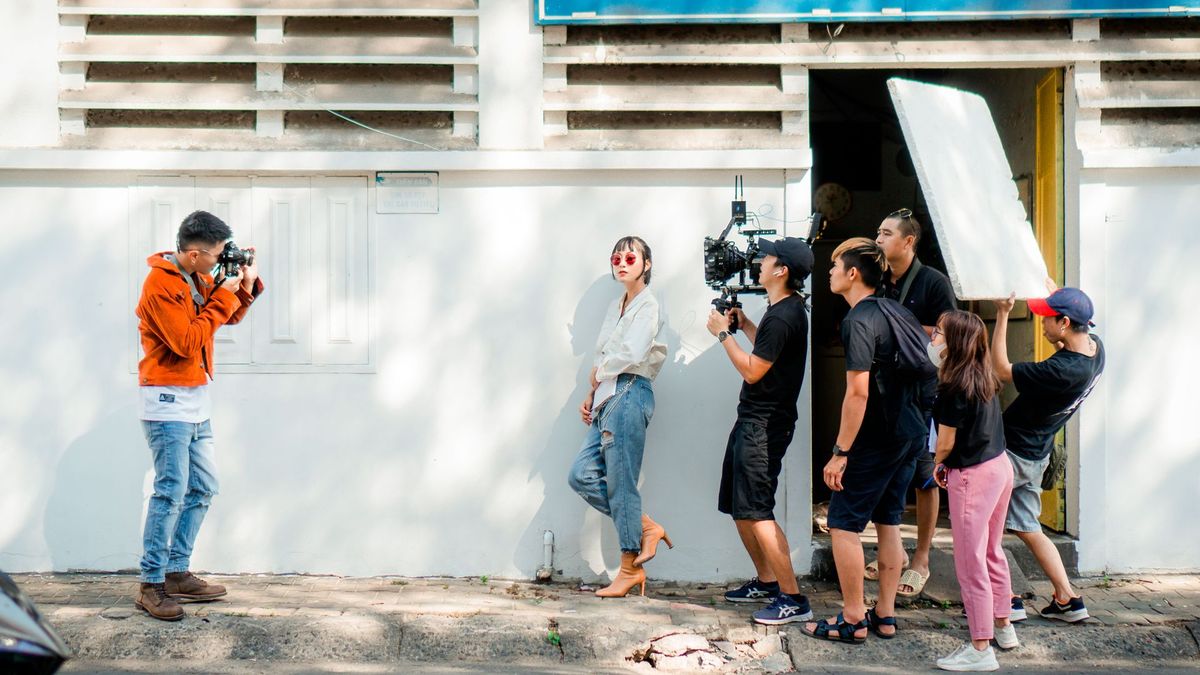
A well-planned shoot is calm. We arrive, walk the locations with your point person, set up the interview area first and record the working footage while people are available to take part. B-roll, the supporting shots of the space and the work, often runs while interviews are being adjusted, so nobody stands waiting.
- Walk-through and setup of the interview position, with sound check.
- Interviews, in the order that keeps people comfortable and their schedules intact.
- Working footage and detail shots of hands, tools, products and spaces.
- Extra framing for vertical or square versions, if planned.
- A quick review of what was captured against the shot list before we pack up.
If you also need staff headshots, employee introduction videos or website photos, planning them together is often more efficient. One corporate shoot, many assets shows how to plan for several outputs at once.
Editing, feedback and delivery
Editing begins with the structure: the order of the ideas, the best answers and where footage supports them. A first cut is for checking whether the story works, not for fine-tuning individual frames. We ask reviewers to focus on whether it is accurate, clear and in the right order. Color, music and small timing changes come after the structure is settled.
Delivery should match your plan. A typical set might include a main version, a shorter edit, a vertical cut, a caption file and a still frame for thumbnails. Say early which of these you need, because adding a version later can mean rebuilding portions of the edit.
Using the video and measuring what matters
A video helps most when it is placed where decisions are made: near the top of a service page, in the first email to a new inquiry, on the page an ad points to. Placing it in only one location wastes the work.
Measure what matches the action you chose. If the action was a call, look at calls and form submissions from the page with the video compared with before. Views on their own are a weak signal; the question is whether visitors who watched were more likely to reach out. Keep expectations modest and compare similar periods, since seasons and campaigns affect traffic.
Refresh a promotional video when the offer changes, when key people leave or when the space looks different. Often a few shots and a new closing line are enough, which is another reason to keep the original footage organized.
What affects the scope
We do not publish fixed prices for promotional video because the work varies widely. The main factors are the number of locations and shooting days, how many people appear, whether extra lighting or audio setup is needed, how many versions you want and how much editing the story requires. A single-location interview with working footage is a different scope from a multi-site piece.
- Shooting time and number of locations.
- People on camera and any coaching or scripting.
- Versions and aspect ratios to deliver.
- Graphics, captions and music licensing.
- Rounds of review and the number of reviewers.
If you are comparing studios, how to choose a Connecticut video production company offers a practical checklist. For the broader overview of what we do, see our corporate video production page, or look through our work.