Events
Backstage presentation and interview coverage at a live event: how we plan it
How to plan backstage presentations and short interviews at a Connecticut event, with access, audio, prompts and backup, drawing on our public Basketball Hall of Fame behind-the-scenes clip.
By Tyler Rivera 8 min read
Some of the most useful footage at a large event is not on the stage at all. It is the short exchange behind a curtain, in a corridor or at a side table, where a person has just been honored and has a few seconds to say something real. Filming it well takes different planning than filming a program from the back of the room.
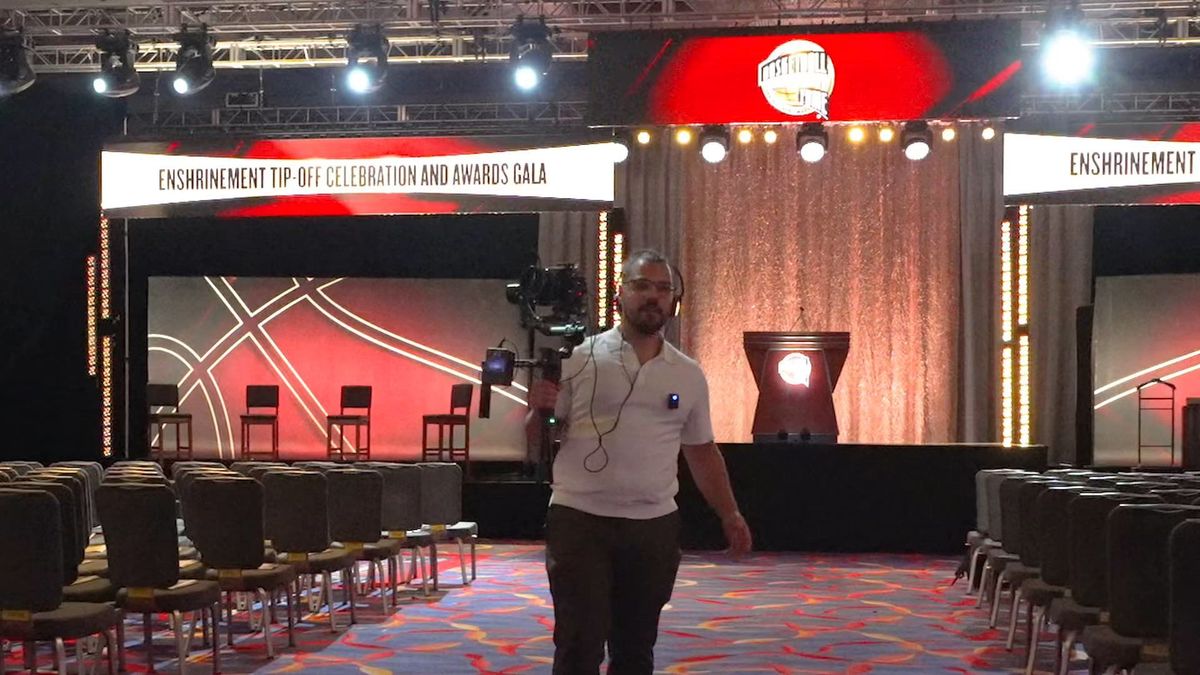
Our public behind-the-scenes clip from the Basketball Hall of Fame shows this kind of work: filming backstage presentations and interviews. The still that opens the clip shows a videographer with a camera on a handheld stabilizer walking through the enshrinement gala ballroom. Below is how we plan backstage coverage for organizers, sponsors and brand teams. You can see more of that assignment in our Hall of Fame project story.
Why backstage coverage is planned differently from stage coverage
A stage program has a fixed shape. There is a lectern or a platform, lighting that was designed for the room, a sound system, and a running order everyone has seen. Coverage of that program is mostly a question of positions and angles.
Backstage is the opposite. Space is tight, the lighting was not designed for a camera, other people need to move through, and the schedule depends on what happens on stage. A person may walk in with only a minute to spare. We recommend treating backstage coverage as its own small production with its own plan, not as an extra that the main crew will squeeze in between other tasks.
That plan has to answer a handful of practical questions before the event, not during it:
- Who is allowed backstage, and who decides when a person is available to be filmed?
- Where exactly will filming happen, and is there a second place if the first is taken?
- What is the route between the stage and that position, and who walks people there?
- Who speaks for the organizer if something has to change in the moment?
- What happens to the footage afterward, and who approves how it is used?
If an organizer cannot answer these a few days ahead, that is useful information. It tells the team where the gaps are while there is still time to close them.
Agree on access, lanes and approval first
Access is a trust question before it is a technical one. A host that is running a large evening has many people competing for backstage time, and a camera crew is one more demand on a limited space. Agree to a clear lane with the organizer and then stay in it, because that is what keeps a crew welcome in a shared space.
For backstage coverage we recommend settling these points in writing with the organizer:
- The area the crew may use, and the areas that are off limits.
- The credentials or wristbands needed, and who issues them.
- The person who has authority on the floor, with a phone number.
- Whether the crew films only the planned presentations or may also film unplanned moments.
- Whether the people being filmed have been told in advance, and whether any of them can decline.
- Who approves the footage before it goes out, and how quickly they can respond.
The last two matter most. People who have been told in advance and given a say are relaxed on camera. People who are surprised by a lens are not, and the footage shows it.
Keep the kit small and plan the audio first
A backstage position is rarely roomy. We recommend keeping the equipment quiet, compact and quick to reset between subjects. Large lighting setups, loose cables and heavy stands are hard to move through a crowded space and can get in the way of other staff.
Audio is where we would spend our planning time. A backstage space is often noisy in ways the room is not: crowd sound, music bleeding through a wall, staff communicating, doors opening. A viewer forgives a plain picture long before they forgive a person they cannot understand. Questions worth asking before the day include:
- Is there a quiet corner, or can one be made quiet for a few minutes at a time?
- Will the person being filmed wear a small microphone, and who clips it on?
- Will the venue's sound system or staff radios interfere with wireless equipment?
- Is there enough power, and where are the outlets?
- How will the team record the room sound separately so the final edit can feel placed in a real space?
Our guide to preparing for a corporate video shoot covers the same ground for an office setting, and the ideas carry over: a quiet space, a test recording before the real one and a person who owns the schedule.
Give people a simple first question
The hardest part of a short interview is not the equipment. It is the first ten seconds, when a person who has just been honored is asked to say something meaningful. A long list of questions makes that harder. A single open prompt makes it easier.
We recommend preparing one or two open questions that the person can answer in their own words, then let them lead. Good prompts tend to ask about a feeling or a person, not about facts:
- What is the first thing that went through your mind?
- Who would you most like to share this moment with?
- What does this mean to you right now?
Avoid prompts that can be answered with a single word, and avoid asking someone to repeat a line for the camera unless there is a real technical reason. If the first answer is good, take it. Repeated takes drain the moment of the very thing that made it worth filming.
It also helps to tell the person how long this will take, where to look and that they can stop. That small courtesy improves the footage more than any piece of gear.
Log and back up as you go
Backstage footage is often impossible to repeat. A person is honored once. That is the reason we advise treating every card and every drive as if it holds the only copy.
A workable routine, for any live event with short, unrepeatable moments, looks like this:
- Label each clip as it is recorded, with the person's name and a rough time, on paper or in a short note.
- Copy the cards to a second drive on site as soon as there is a calm moment, before the equipment is packed.
- Keep the original cards separate from the copies until the project is delivered.
- Write down who approved what, so the edit does not have to guess.
Logging may sound like administrative work. It is the part that makes a fast, accurate edit possible, because the editor can find the person who said the best line without watching hours of footage.
What backstage footage can and cannot be used for
It is worth deciding the uses before the event, because the answer can change what the crew records and what the organizer asks of the people on camera. Backstage clips are often considered for these uses:
- A short recap shared with attendees, sponsors or members after the event
- Social media clips, where the person speaking carries the message
- A highlight film that cuts between stage moments and backstage reactions
- Internal archives that preserve a milestone for the organization
Each use asks for different permissions. A clip kept in a private archive is not the same as a clip posted to a public channel or placed in an advertisement. If a sponsor appears in the shot or a brand is visible, that can also matter. Ask the organizer, in plain words, which uses are expected, and confirm them in writing. Our guide to event highlight reels goes further into planning for the days after an event.
How backstage coverage affects an event budget
Backstage coverage changes scope, and scope is what a quote is built from. A few things in particular add time or people:
- Dedicated coverage during the hours when presentations happen, separate from the main program
- A second person for audio, logistics or an additional angle
- More editing, because short interviews usually become several short clips
- Extra rounds of approval when several people appear on camera
- Backup and file handling for footage that cannot be repeated
None of these is automatically necessary. A small event with a single presentation may need very little, and a large evening with many people passing through may need more. The useful move is to write down what you want to capture before asking for a quote, so the proposal reflects it. Our companion piece on budgeting for event photography and videography explains how to compare quotes line by line, and our videography pricing overview covers why prices vary across project types.
Questions to ask any event videographer about backstage coverage
If you are comparing teams, these questions reveal how they think. We are glad to answer them ourselves.
- How do you agree on access and lanes with the organizer before the event?
- How do you handle audio in a noisy space, and what do you do if wireless equipment is disrupted?
- How do you approach short interviews with people who are not used to being filmed?
- How do you log and back up footage during the event?
- What are your expectations about who approves the footage and how quickly?
- Can you show me a behind-the-scenes clip or a full sample, and explain what I am looking at?
Behind-the-scenes footage, like ours from the Hall of Fame, shows how a team works. A finished sample shows what you would receive, so ask for both.
Common questions
Is this the same as filming the main event program?
No. Program coverage focuses on the stage, the speakers and the room. Backstage coverage focuses on moments that happen away from the audience. Some events want both, and they can be scoped separately.
Does a behind-the-scenes clip show what I would receive?
Not exactly. It shows the working environment and how a crew operates. The deliverables for your event are agreed in your own scope.
Can you guarantee a specific moment will be captured?
No team can guarantee a live moment, because events change. What a team can do is plan positions, audio and backup so that the chances are as good as the circumstances allow, and tell you honestly what is outside their control.
How early should we talk about backstage coverage?
As early as you know it is a priority. Access and approvals take the longest to arrange, and they are the part an organizer controls.
Where to go from here
If you are planning an awards night, a gala or a company event and want to talk through backstage presentation and interview coverage, our fundraiser and gala videography page and our corporate event videography page describe how we approach coverage. You can also see more of our public work in the portfolio. Bring your questions, your concerns and the list of people you most want to capture, and we will help you decide what is worth planning for.